
WHEN THE ASH SETTLES
Dalia Oliver and Thomas Serrano
Part I: Uprising, Armed Struggle, Civil War
The First American Soviet
But one day in your brokenness
Breaking the yoke, you arose
You wanted it to be everything
from everyone, like in Christ
To the first soviet of America:
They turned it all to shit by gunfire
Pedro Geoffroy Rivas, "Un Romance de Enero" (1935)
The day of El Salvador's 1932 uprising, volcanic ash blanketed the sky. By mid-afternoon, the sun appeared not to have risen at all. Birds collided into each other in their confusion. For the thousands of people living in the western departments of El Salvador, nothing marked the transition into night. Then, rocket flares filled the sky over Santa Tecla, Sonsonate, Izalco and Ahuachapán. The sounds of conch shells and whistles accompanied the flames of flares, announcing the insurrection. As many as seven thousand insurgents—indigenous peasants alongside ladinos and others—descended on military barracks in Sonsonate, Tacuba, Santa Tecla, and around San Salvador. Insurgents drew members from across El Salvador's working poor, defying rigid categories of race and political ideology.
A seventy-eight-year-old Indian named Lino Argueta led four hundred men into the nearby town of Colón to retrieve nearly one hundred machetes that had been confiscated by the authorities there. They hoped to use the weapons to siege a barracks in Santa Tecla. Argueta died in the raid. He rallied his men until he collapsed.
Killing the Just As Though They Were Sinners
The Salvadoran government, led by General Maximiliano Hernández Martínez, brutally suppressed the uprising. The military defeated the rebellion with indiscriminate machine gun fire and pursued survivors into the mountains. In the following days, soldiers massacred Indians. They conducted targeted, discriminate killings of Communist voters, assembled on Las Listas—kill lists provided by the government. The saying, “Mataron justos por pecadores” (They killed the just as though they were the sinners), entered everyday parlance as rural communities made sense of the repression. Martínez’s men killed more than twenty thousand people. The 1932 uprising is known primarily for the counter-revolutionary brutality that followed—La Matanza, the Massacre.
The government outlawed the Partido Comunista Salvadoreño (PCS) and executed its most prominent figure, Farabundo Martí, a veteran of Augustin Sandino's anti-imperialist war against the US Marines in Nicaragua. Martí escaped arrest and assassination a dozen times prior. The PCS went underground and operated clandestinely. Throughout the 1940s and 1950s, regime changes, coups, intensification of coffee production, and soaring prices spurred industrialization. The country’s wealthy, land-owning oligarchs partnered more and more with multinational corporations.
Last winter, you told me you wanted to go to Central America to study Spanish and find comrades. I didn’t know then what drove you. I didn’t know you felt, perhaps more sharply than I did, the limits of our work in the US. I didn’t know your family history. I didn’t know your father, a young, naive enlistee, ended up God-knows-where in urban combat he still can’t make sense of. I didn’t know your grandfather, who died just as you found your voice to challenge him, had been a Green Beret instructor—first at the MACV Recondo School in Vietnam, then at the School of the Americas in Panama, where he trained the Bolivians who eventually captured Che.
My earliest memory of politics is the pockmarked telephone poles and abandoned adobe walls of my mother’s hometown in Chalatenango, the northernmost region of El Salvador. I would soon learn that my very birth depended on a chain of events: the day a guerrilla blew up a bridge, the scorn of a demonic paramilitary uncle, narrowly avoided conscription, and countless other contingencies in the tangled stream of history.
Since then, I have walked knowing the earth beneath me might one day tremble with the shock of revolution—that every valley could rise, every mountain flatten, and the rushing current of history could sweep us across this broad, open plain.
We came of age in the long shadow of Occupy Wall Street and the Arab Spring. We felt the bone-chill of water cannons at Standing Rock, the otherworldly heat from a burning police cruiser. We learned the steady work of building collective infrastructure and doing anti-fascist research. We confronted what we didn’t know about making revolution in the US as we tried to keep police out of the forest and comrades out of prison.
All the while, we studied our peers in Hong Kong, Chile, Myanmar, and beyond. We came to see how revolution at home depends on the fate of revolutions abroad, and vice versa. We understood, as clearly as day, the task of forging new connections across borders.
Someone has to do it, we said to ourselves. So, giving each other a nudge, we planned a trip.
I've traveled to El Salvador every year for most of my life, always to visit family. As Bukele's government won favor across the hemisphere, particularly up North, I felt more urgency behind my long-held desire to establish political ties between our comrades in the US and those in El Salvador. We needed to connect with militants of the historic revolutionary forces of the Civil War and those struggling against Bukele's regime now, to understand their past and present struggles. We hoped to share a bit about our own organizing too.
A few months passed, and we took our task more seriously each passing day. We read books about the history of El Salvador, skimmed articles, studied maps. We booked our flights and bus tickets. You were on your way to Guatemala. I chased cold-calls and half-leads from the Rust Belt while you studied Spanish and established contacts there in Guate. I would meet you in Guatemala City with a sketch of a plan and a voice recorder.
We took the bus together to San Salvador. On our way, we watched volcanic peaks crawl across the horizon as the bus passed by the Cordillera de Apaneca mountain range. The bus hummed through the central plateau to its north and east. Today, the plateau is crisscrossed by a logistics corridor, and the mountains are wrapped in a circuit of domestic tourism attractions. Large warehouses dot the side of the highway against a backdrop of volcanoes. Breweries strung with patio lights nestle into the mountains, many of them gated off. In the flood plains below, housing developments offer the minimum legal definition of a house in exchange for the average value of a subsidized loan from the state. The once-fertile plains, still green with cane, are now a reservoir for the finance capital of the Salvadoran elite and cartel bosses alike.
We'd spend a few days in Apaneca, not far from Juayua, where insurgents seized the town in 1932. Today, the whole place bustled with municipal and retail workers preparing for nightfall. The town was preparing to celebrate the Nativity of Mary, and every town on La Ruta de las Flores would commemorate her birth with a lantern festival. Above the plaza by the church, municipal workers better-accustomed to desks and keyboards teetered on rolling scaffolds as they hung lanterns. They smiled playfully as you took their pictures. As we entered the church, the walls reverberated with the sound of a rambunctious marching band. They’re half as numerous as they sound, and about half the height you expected: you’re impressed to learn they are schoolchildren. Their sense of rhythm is strong, even if they fall out of order circling the courtyard.
We're on our way to the capitol. Once there, we linger in the plazas, meander through the Historic Center. "What is haunting this place?" you asked me. You don't know it was once the bustling center of El Salvador's informal economy. Then came the regime's forced displacement of street vendors. Now the Historic Center is the crown jewel of Bukele's program of social cleansing.
Squinting through the glare of sun-bleached concrete, we watched uniforms march through the plaza: CAM municipal police with their mall-cop gait, DOM workers tearing up shrubs to widen the pavement, guards posted at the National Palace. That morning, all was quiet. Forty-five years earlier, death squad bombs and bullets rained down on the largest single protest in Latin American history—Oscar Romero’s funeral. Dozens died; hundreds were trampled in panic. Four months after we left, a soldier shot a woman dead in the same plaza, in broad daylight. The regime called it an accident. Her blood was quickly power-washed off the concrete, into the news cycle's river of amnesia.
We arrived in Bukele's San Salvador and looked on his works. We set out to find our friends, his enemies.
The Long Night (1932-1970)
In the decades following La Matanza, the counterrevolution consolidated its rule over El Salvador. Dictators ruled in succession until 1979. The PCS and other revolutionary factions effectively disappeared. The country's peasants were further crushed by exploitation and repression. Through the 30s-50s, the national oligarchy concentrated their land holdings and intensified coffee production for export as a cash crop. Land consolidation left many peasants landless, and dependency on coffee exports left the Salvadoran economy vulnerable to volatile commodity prices.
To address these issues by diversifying the economy and employing newly urbanized workers, the reformist and “modernizing” dictatorship of the 60s attempted to industrialize the country via import-substitution. This process coincided with the slow rebirth of the PCS, inspired by the Cuban Revolution in 1959. The party established fledgling experiments in armed struggle, but they never fired a shot in anger. After a decade of heavy repression of labor organizing and electoralism, a minority within the PCS—including their Secretary General, Salvador Cayetano-Carpio—concluded armed struggle was the only path to revolution in El Salvador.
The United States increased its presence in El Salvador. In 1964, the CIA helped establish ORDEN, a Green Beret-trained anti-communist paramilitary organization responsible for some of the worst repression in the country.
¿Independencia para quién?
It’s the first Independence Day of Bukele’s illegal second term. The sky is a solid sheet of gray. All morning, the echo of drums and fireworks marches through the window. We dress to the rhythmic drumming. Police have cordoned off the center of town, and an hours-long procession of school children march in uniform down the main boulevard, performing their now-obligatory patriotic routine. This is only the second Independence Day since Bukele gerrymandered 262 Salvadoran municipalities into forty-four new ones, one fifth the previous total. The children’s parade routes are now five times as long and twice as muddy, soiling the spectacularly white socks of their regime uniforms as they're paraded throughout the country.
We don’t head any deeper into the city to watch the parade. We slip past the police cordon and wait for our ride at the edge of town. Our destination is well north of the Plaza Salvador del Mundo. A few days ago, we shared the plaza with a few young skaters. Today, the crowds are lined up all the way down to Parque Cuscatlán, and they're following the Independence Day parade route down the Alameda Franklin Delano Roosevelt.
Our driver rolls his eyes at the spectacle and keeps us far clear of the Salvadoran special forces' parade floats and the helicopter airshow. The streets were cleared out by the holiday, devoid of vehicle and pedestrian traffic. We make it to our destination in record time.
The Director opens the door promptly, greeting us with a warm smile. We brought sweet breads to share: salpores, viejitas, semita, peperechas, the works. The Director teases me for having the Salvadoran trait of being a pandulcero and puts on the coffee pot.
The President steps out from her office and greets us as well: "Can I offer either of you some water? Let me get that for you. . .Please, pull up a seat."
We sit down with our water and coffee, each pulling out a notebook and pen. We hit record on the voice recorder and begin.
"How long has it been? It feels like you were just here!"
Some months ago, we met The Foundation for the first time. We knew of them through their publications, including one impressive overview of guerrilla medic operations during the war. It is packed with dozens of interviews with former guerrillas, including internationalists. It took four people, in total, relaying messages from us, to put us directly in touch.
We rang the bell of a heavy metal door. A student volunteer peeked through the small glass lookout, opened the door for us, and led us to a nondescript waiting area in the front of the building. Some older men were wrapping up a meeting center room. The Director came out, showered us in warm greetings, and showed us around: "Here is the book display of our publications, here is our mock up of an underground broadcasting bunker for Radio Farabundo Martí, our main meeting room is also an exhibition space. . ."
In the main room, two ex-guerrillas of the Fuerzas Populares de *Liberación* Farabundo Martí (FPL) are tagging photos from the Civil War for their archive. They project the photos on the wall.
"This girl and that boy got married during the war. See how the boy is not wearing any socks? Imagine roughing the mountains in no socks! This child begged to fight when his parents were killed. We couldn't hold him back. He threw himself headlong into the frontlines."
They see us looking on. We exchange introductions. They recognize my surname and show us photos from the plaza at the center of my mother's hometown in Chalatenango. They turn to you, and jest at your fair skin and clear eyes: "What part of Chalate are you from?"
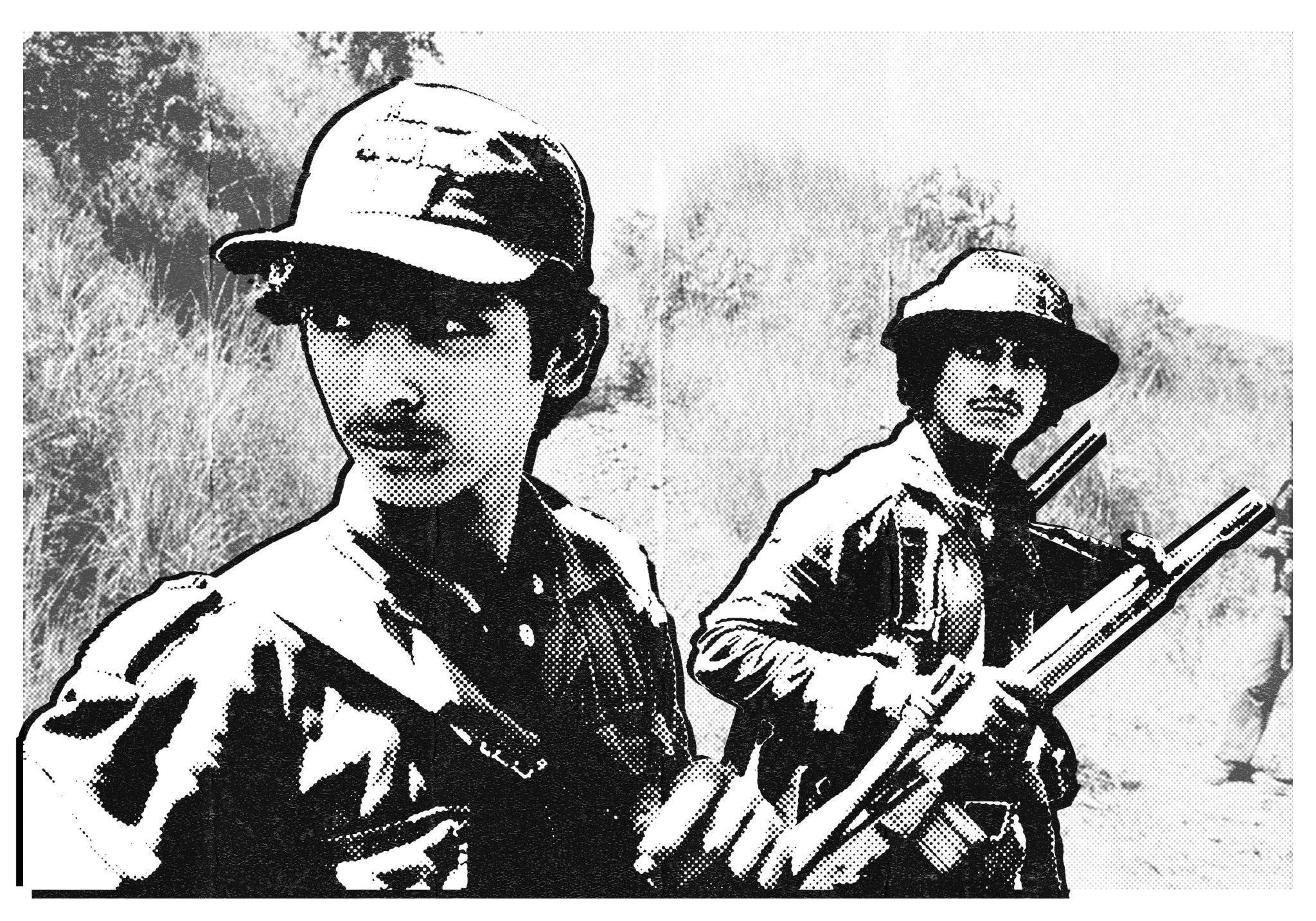
October 21, 1983, El Salvador. https://www.robertnickelsberg.com/elsalblackwhite
We take our seats. The Director pulls out her notebook and puts on her glasses. At first, we have a difficult time explaining who we are and why we are there. We find ourselves clarifying we are neither journalists nor students. You joke that you hope history will not call us activists, either. We settle in, grow more candid with her.
"The people of El Salvador were not wrong to think they could win a revolution," you tell her. "It would have taken a proportionate crisis in the US." Her posture relaxes, and for a moment, the room is silent. She gives us a knowing smile.
The Fuerzas Populares de Liberación Farabundo Martí (FPL)
We're back at The Foundation for the fifth time, a few months later. Our last time, we presented on the long arc of US social movements and rebellions since the Occupy movement. This time we had a chance to see the archives. You pull out a box, and from that box, the internal organizational chart of the FPL, written in pen on now-delicate paper.
"You have a strong intuition for where you'll find the good documents," The President tells you.
Of the five politico-military organizations that would constitute the FMLN, the FPL was the first. The FPL was founded by the Secretary General of the PCS, Salvador Cayetano-Carpio, on April 1, 1970, marking a split from the PCS. Its founding strategy advocated for prolonged people’s war against American imperialism, drawing from the Vietnamese example, adapting it to the Salvadoran and Central American context. The FPL contrasted their strategy to focoismo, the strategy advocated by Che Guevara.
The FPL operated under a method of trabajo compartimentados (compartmentalized work) in which members lived clandestinely under pseudonyms, organized in cells and small agencies working independently, and knew no more than necessary about the going-ons of other cells. The method of compartmentalized work allowed the FPL to develop operational and strategic continuity while evading political repression as the organization matured.
The FPL did not believe small, clandestine cells could win a revolution. Instead, this period was the first stage of organization en route to a popular war. The link between the mass movement and the armed wing was fundamental to their theory. The FPL formed clandestine grupos de apoyo, or support groups, that directly supported the armed component while intervening in mass struggles.
In August 1972, the FPL released their first proclamation and activated their commando units. The commandos bombed the Argentinian Embassy in San Salvador. Soon, commandos reorganized into militias. By 1976, the militias were once again reorganized, this time into local guerrilla units. The guerrilla units would go on to form a mobile regular army.
"This book is about my sister," The Director told us, as she stood behind the glass case of books and gestured at a stack of some of the older books on display.
She tells us her sister and two other comrades were some of the first martyrs of the FPL in its urban guerrilla phase. They were responsible for a safe house in Santa Tecla. One day, the house was besieged by the Salvadoran Army. They fought for eleven hours, enough time to burn identifying documents and other materials that would risk the lives and freedom of other FPL members. Knowing they would not make it out of the house alive, they took their own lives. Their deaths became part of the FPL's internal mythology.
Our conversation drifted with overflowing excitement. You asked if we could look through the archives; we were hoping to find documents with captivating graphics to scan and reproduce for a fundraiser. First we went for the box of El Rebelde, the internal ideological organ. "I used to have a huge stack of El Rebelde", The Director said. "My father burned all of them."
We fished out an organizational chart from a few years before the war. The President exclaimed that she had goosebumps. She recalled those years, when the FPL sent fifty militants to Cuba to receive military training and form the core of the popular army back home. Then Sandinistas launched their insurrection in 1979. The FPL debated how to respond.
"Were you one of the twenty-five who went to Cuba, then Nicaragua?" you asked her.
“Me!” she exclaimed. “Of course!”
The popular mass movement arm of the FPL, Bloque Popular Revolucionario (Revolutionary People’s Block, BPR), was founded in 1975. Between 1979 and 1980, the BPR was the largest and most combative politico-military organization in the country, with an estimated 60,000 members.
Meanwhile, in the US, repression against Central American solidarity movements marked a novel reconfiguration of collaboration and information-sharing between the FBI and CIA. The CIA solicited forged intelligence materials from Salvadoran intelligence agencies and the National Guard of El Salvador, one of the most repressive law enforcement agencies in the world at that time. The CIA then passed those documents along to the FBI. The FBI, in turn, shared intelligence with a secret network of right-wing Salvadorans, located in Miami, who gathered information on left-wing Salvadorans fleeing to the US.
PART II: "NEGOTIATED REVOLUTION"
And the president of the United States is more president of
my country
than the president of my country
Roque Dalton, "OAS" (1970)
A few weeks before we left for El Salvador, we happened across In the Name of the People, a 1985 documentary in which four filmmakers sneak into El Salvador in the midst of the Civil War and document a group of guerrillas as they head for Guazapa to launch an offensive on the capital. We were a short drive from Guazapa with an open day on our itinerary. A few online search queries later, we found a phone number associated with the Museo de Guazapa. With no guarantees of a response, you message the number. The recipient responds: the museum project was abandoned before it could open due to the "adverse political situation" in El Salvador. They offer to show us around Guazapa anyway.
Two days later, we're in a car on our way there. Our driver is confused why we want to go to Guazapa, of all places, but he drops us off near the central plaza anyway. The surrounding roads all seem to converge at the base of the Cerro Guazapa, the long-dormant volcano looming over the town. The central plaza sits no larger than a gas station. There must be a hundred people bustling about: families leaving the nearby church collect themselves on the benches; children and teenagers sit on the waist-high stone retention walls eating lunch and talking with their friends. A street vendor on the corner mans a table of tactical gear and toy guns. You spot a hot pink balaclava fitted over the head of a mannequin and try to imagine the best occasion to wear one.
Tunnels of vine-covered arches mark each corner of the plaza. They converge in the center. We enter the archway closest to the table of tactical gear. Where the paths converge, there is a small fountain, three ceramic pots stacked one on top of the other. The fountain is dry. The water has long since been turned off.
Soon enough, our guide calls. He has arrived at the plaza. We exchange introductions. His eyes scan us up and down. He checks his watch.
"You're dressed for a hike up the cerro, but we won't have time," Roberto tells you. "It's a four hour hike to the top."
We hoped to traverse the real trails of the cerro used by the revolutionary combatants of the Civil War, not that turistica joke of a trail that’s fallen into disrepair due to budget cuts. We wanted to climb into one of the tatus, the underground bunkers and tunnels used by revolutionaries during the war, inspired by those of the Viet Cong. The smallest tatus are narrow bomb shelters one can dive into at the sight of air assets. The largest tatus are proper military bases; they once hosted the guerrilla infrastructure necessary to launch attacks on the US-backed Salvadoran Army. The tatus, abandoned since the end of the war, are languishing too. But they persist. Much like their old inhabitants, they cling to the mountainside with stories to tell.
“They say that during the war the Guazapa Cerro was la flecha en el corazón del enemigo (the arrow in the heart of the enemy),” Roberto tells us. “But in truth, we used to say it was la flecha en el culo del enemigo (the arrow in the asshole of the enemy).”
Roberto grew up on the Cerro Guazapa, and the Civil War began when he was only four years old. His family fled, like many others, from the mountain into the town. "I was too young to fight," he says. "But I would have if I was just a few years older.”
As we round the corner, we tell Roberto a bit about ourselves and what brought us to Guazapa. His face lights up.
"Many ex-combatants are gathered in Guazapa today for a meeting," he says. "Let's see if they will speak with you."
Balance of Forces
On November 11, 1989, days after the fall of the Berlin Wall, the FMLN launched its final offensive, the Offensiva Hasta el Tope. After twenty years of armed struggle and ten years of open civil war, revolutionaries brought an armed offensive into the urban core of the capital for the first time. In an echo of 1932 and 1981, revolutionaries again sought to foment a general insurrection. Because of unanticipated massive aerial bombardment of proletarian neighborhoods and weaknesses in their urban organizing, the FMLN did not achieve this goal. Without a general insurrection, despite their brave fighting, the guerrilla army could not militarily collapse the Salvadoran Army.
For the Salvadoran armed forces, the offensive proved that despite practically limitless yankee cash and arms, they had not eroded the guerrilla capacity to organize a massive attack. Brutal repression of the population was a double-edged sword that encouraged more resistance than supplication, and the state's incomplete implementation of American-backed reforms did not effectively undercut the economic grievances that motivated the struggle. Thus, a military victory in either direction seemed impossible, and the consensus between the guerrilla leadership and the mass movement aspired to find a political solution and peace.
At this time, the socialist bloc, serving as the international rearguard of the FMLN, came apart at the seams. The FMLN could not entirely rely on domestic bases of operation and logistics, and the socialist countries supported the FMLN's military advances with arms, training, and intelligence. In 1979, fifty FPL combatants went to Cuba for training in order to then become the core of the FPL armed forces. In Nicaragua, when the 1978-1979 offensive to overthrow the Somoza regime reached a critical juncture, twenty-five FPL combatants formed the Farabundo Martí internationalist brigade, departed from Cuba, and went on to participate in the final blow against Somoza. With the Frente Sandinista de Liberación Nacional (FSLN) well established in Nicaragua, the FMLN could count on Managua as a headquarters for their military operations and the Nicaraguan territory as a steady logistical corridor for arms shipments from far-flung allies. By 1989, this arrangement collapsed.
On October 18, 1989, Honduran soldiers interdicted a van loaded with Soviet-made small arms en route from Nicaragua to the FMLN. Such shipments had long been suspected by American intelligence, but this was the first one to be publicly known. The revelation inconvenienced Soviet diplomatic efforts to improve relations with the United States; the US State Department summoned Soviet ambassador Yuri Dubinin to answer for the van-load of rifles. Only a visit from the Soviet Foreign Office Chief on Latin America, Yuri Pavlov, could smooth things over. But, on November 25, 1989, weeks into the final offensive, a plane carrying surface-to-air missiles bound for the FMLN crashed in Salvadoran territory.
Up to this point, the Salvadoran Army retained air-superiority; they had uncontested capacity to operate aircraft over Salvadoran territory, which allowed them to helicopter quick reaction forces and bombs deep into guerrilla territory. While the FMLN did develop sophisticated and novel techniques for using small arms to shoot down rotary-wing aircraft, without these missiles, they could not turn the tide of the war; thus, the missiles were sufficient threat to Salvadoran-US interests to trigger diplomatic action from the US.
Soviet diplomats feared the missile incident would threaten the Malta Summit between President Bush and Gorbachev set for December 2. While the summit went as planned, US Secretary of State James Baker demanded the Soviets take action to prevent Cuban and Nicaraguan rearmament of the FMLN immediately.
Two days later, Moscow ordered a freighter laden with four helicopters bound for Nicaragua to immediately return to port in Leningrad. Additionally, the Sandinistas, preparing for an election in February of the following year, requested emergency funds from the Soviets in order to provide consumer goods to Nicaraguans. To pressure the Nicaraguans into compliance, the Soviets denied this aid.
On December 12, at the Central American summit in San Isidro, Costa Rica, President Ortega of the FSLN repudiated the FMLN, signing a declaration demanding that the FMLN immediately cease hostilities and endorsing the existing Salvadoran government. The Sandinistas publicly buckled under combined American-Soviet pressure, sending a clear message to the world: the Salvadorans were now on their own.
Guazapa: La Flecha en el Corazón del Enemigo
We climb the stairs up to the FMLN party house. A few ex-combatants leave, but most linger, talking to each other, rallying children. Roberto ushers us into the pavilion. Four women greet us, inviting us to pull up chairs. Four more ex-combatants pull up chairs, then another five. A circle forms beneath a floor-to-ceiling mural of Oscar Romero. A disco ball hangs from the rafters above his head, glimmering in the sunlight. One of the men introduces himself by his nom de guerre: Fernando.
"I'm giving you my pseudonym for safety reasons. We're still in the game," he says, winking.
We thought we'd be a quarter of the way up the Guazapa Cerro by now, but the mountains here make their own plans. We're not prepared to interview a dozen or more ex-combatants, but we know where to start. You pull out a Zoom recorder. We introduce ourselves and hit record.
"Some of us joined the guerrilla not because we were brave, but to save our own lives," says Ana María. Ana María is the oldest ex-combatant at the meeting. She joined the FPL in 1975, one year before The Director's sister and her husband sacrificed their lives defending the safe house in Santa Tecla.
"All of the women here are our comrades who lived in San Vicente, where we were during the war. But when it ended, we didn't have the courage to go back to live where we had our land. We had to go to another place where no one knew us to start anew. It doesn't mean you forget your roots because you fought. But you know that where you lived there are people who would probably kill you if you returned. After the peace agreements, many comrades were killed."
Ana María's son, René, is an adult now and he brings his elderly mother to ex-combatants' meetings. Born near the close of the war, René's childhood took place against the backdrop of the Peace Accords process. As an adult, he witnessed first-hand the neutralizing effect the Accords had on political organizations and the disillusionment of surviving guerrillas within the FMLN.
"The government itself, the politicians in power, encourage crime," René tells us. "They start asking for help to fight crime, to fight drug trafficking, to fight everything. And what kind of help do they need? Many millions of dollars in loans. For that, they need to have a population full of criminals, or at least to create that image in front of everyone. After the war, they encouraged crime because they needed resources. Gangs were used politically this way because the politicians were friends with the criminals. In the end, that money was going to end up in all of their hands."
"The revolutionary struggle governed as a political party," Fernando adds. "In the end, I would call this a mistake.”
He notes that President Nayib Bukele came of age in the same post-war youth movement as Ana María's son and another man at the meeting. Once in power, the FMLN did not abandon previous regimes' strategy of leveraging gangs, social violence, and policing as a method of social control. Instead, the party developed treaties with gangs and oversaw a major escalation in police militarization.
"In the end, the process of struggle created fear. Yes, that process [of continuing the revolutionary struggle as a political party] was carried out using gangs," says Fernando.
"The State of Exception has not benefited us. The regime was built to confront the gangs. Many people were wrong about that. The State of Exception is not against gangs, it is against us, against the people. Gangs are obviously against the law. So, [the soldiers and police] go, they capture them, they put them in prison. But the State of Exception is against the people. Now, if we were to organize ourselves, they would take us away for illegal association. They'd put us in jail for illegal association. And we would be locked up under the State of Exception. So, what does that mean? That they don't allow us to organize."
Ana María must leave before the others. Her trek home is a long one, and she needs to be back before dark. She takes your hand and holds it between her palms. The decades have left marks like contours of mountains on the back of her hands.
"Look, jovenes, when you come back, I can welcome you to my community," she says. "I can organize the people there so that you can engage with them however you want. I'll be waiting for you whenever you want to visit. We'll gather people so that they know we have to take to the streets, and that we have to take to the streets of other places, too."
Fernando rests his arm on your shoulder. He looks you in the eye and asks, "Do you understand what we mean by compa?"
"Yes, I think so," you say, your eyes tearing up.
"Thank you, compas,” he says, hugging us both. “Come back with your friends. We'll see what crazy shit we can stir up."
He casts you a mischievous smile. He gestures as though he's holding a rifle at his waist, then fires it twice into the air.
We left the FMLN party house in a buoyant daze. Roberto offers to show us what he has of the collection that, under different circumstances, would have seeded the Museo de Guazapa. We wind through Guazapa together. Meanwhile, dozens of teenagers in school uniforms zigzag through the streets on their way home for dinner.
The Guazapa Museum is four moldy boxes in the corner of an art studio and workshop, piled between a heavy steel door and a well-worn drill press. Roberto tells us projects like this are languishing all over this humid, paper-moldering country. The Bukele administration has pulled funding for historical memory projects, especially those preserving the memory of the Civil War.
Leaning on the pile of boxes is a chintzy katana, the promotion gift of some National Guard officer. Less than thirty kilometers from San Salvador, Guazapa was unusually close to the capital for a guerrilla base. It had the dishonor of hosting an army base as well, making for an unceasing game of cat-and-mouse over the ridges and crevices of the volcano during the war. Air assets and artillery criss-crossed the highway, bombing the cerro night and day. The guardsmen probably didn’t fight many guerrillas here in town. Attacks in town were rare, so most of the business of guardsmen in-town was to repress and murder civilians. Perhaps the guardsmen spent hours staring at the mountain, listening to the thunder above.
Here is where the Guard headquarters was. There is where the artillery was staged. Down this way was the Guard quarters. All of that has been built over now.
In the top right of the pile sits a box full of photographs depicting guerrillas. One photo shows a squad moving through a field crouched and camouflaged in the same grasses that grew all around them on the cerro. These were the Fuerzas Armadas de la Resistencia Nacional (FARN) special forces in training. Displayed together, they could make a fine introduction to guerrilla special forces as a unique innovation of the FMLN. Another glance, and you feel the hot wind blowing across the plains around the mountain, rustling the tufts of grass on their backs. They are wordless and tense, frozen mid-step towards the capital.
There are some familiar faces in the box: Comandante Schafik Hándal, center in a row of other stiff-backed leaders; left-wing TV-journalist Mauricio Funes, leaning to camera, thrusting his microphone forward into a table of dirigentes. If you told any of the men in the photographs which of these two men would lead the FMLN as the elected president of the republic, you’d be laughed straight out of the tatu.
After digging through the prints, our eyes wander over the remaining boxes. You paw halfheartedly at the jutting eagle-head pommel of a rusty combat machete, but it has nothing to say.
Across the street, we're treated to some coffee and sweetbreads in a humble café. As I dip my salpor into a cup of coffee, the baker chuckles, "You're eating that salpor like a Chalateco." A curious boy can’t help but stare from behind a doorway; he warmly returns a smile and greeting. A gentle rain comes in, pattering down the leaves of a tree from which Roberto refuses to trim a single branch.
Leaving Guazapa, we're caught in traffic. Ahead of us the whole way, there is a gang of soldiers hitchhiking in the bed of a bright red pickup. They are all smiles, bantering and scrolling on their phones. You’re sure one of them must be playing Candy Crush. Their patches make it clear; these are 4th Infantry Brigade, stationed at El Paraiso, once the lamentation of many a Green Beret.
The driver drops off the soldiers at a mechanic shop at the edge of town. Locals have likely seen this scene before. It has been a while since guerrillas have overrun El Paraiso, a long time since a guerrilla made their nest in the tall trees overlooking town.
Peace Accords
FMLN leadership signed the Peace Accords on January 16, 1992. International headlines announced an exemplary “negotiated revolution.” A ceasefire followed two weeks later. The FMLN disarmed. Thousands of ex-combatants surrendered their weapons. Ex-comandantes and government officials traveled the world, preemptively declaring the success of the negotiations: liberal democracy had finally arrived in El Salvador, sixty years after La Matanza. The FMLN transitioned from an insurgent political-military organization into an electoral party.
Many insurgents remained hesitant to turn in their weapons. Death squads continued to conduct political assassinations against FMLN members, killing an estimated twenty-four people before the Peace Accords reached their second anniversary. Assassins targeted another one hundred people in that same period. Party officials defended the Peace Accords while skepticism spread among rank-and-filers and mid-level cadre. Did the costs of the war justify the compromises taking place?
Two guerrilla commanders, Francisco Velis ("Miguel Hernández") and Heleno Hernán Castro ("Carmelo"), were murdered in October 1993. President Cristiani denounced the murders, but he did little by way of investigation. The killers were never identified.
At Carmelo's funeral, ERP leader Joaquín Villalobos warned the press that these assassinations could heighten the indignation of the Salvadoran people and disrupt the already tenuous trust in the peace process. "I can't tell our people to trust the peace process with three deaths a week," he said. "Some sectors of the FMLN itself could react against the party's line to stay calm and act on their own."
A few days later, forty people dawning FMLN bandanas burned tires and graffitied the building of El Diario de Hoy. They accused the paper's director of being the spokesperson of the death squads.
The Salvadoran Revolutionary Front (FRS), who identified themselves as mid-level FMLN commanders acting independently of party leadership, sent a communique to national television channels following the small rebellion. The FRS charged the members of the oligarchy with promoting the death squads. They warned that the business magnates and their fancy homes in the wealthy neighborhoods of San Salvador would become military targets if the assassinations continued.
The Fate of Social Movements
Elena leans into the table, "Where is class consciousness in the postwar period? It doesn't exist. What exists is the blurring of a whole host of needs, supposedly unique to each person, that cannot be resolved by a comprehensive solution. In peace, we see this fragmentation of interests. Fragmentation: that's the postwar period in this country. Not only in this country but all over the world. It's an international agenda."
"What has turned everything upside down and fragmented class interests?" you ask.
"Imperialism—under which we are still dominated," she answers.
"I will take it upon myself to sound like a dinosaur because I use the word imperialism. The thing is, they banned us from NGOs, they banned us from speaking in revolutionary terms. They came here and they established a different language. They turned feminism, which was a movement of respect for human beings, into an individual interest, turned feminism into a trend: liberal feminism, feminism for civil rights. And thus, feminism cannot be revolutionary, and a man cannot be a feminist."
Before and during the war, politico-military organizations and the mass movements often worked in concert. For example, the first offensive of 1981 coincided with large strike actions. To foment a general insurrection, support groups bridged the gaps between mass groups and the guerrillas. During the war, the constant threat of bombardment and attack by the Salvadoran Army contributed to widespread deferral to, and dependence on, the military units of the FMLN by poor Salvadorans. The FMLN often warned people of imminent attacks and provided instructions for evacuation. This effectively established a chain of command that persisted after the war's end.
"After the war, the dependency intensified," Miguel, an ex-combatant, told us. "The government began to co-opt all of the social movements."
Many Salvadorans wanted stability and peace after years of fighting. The FMLN did not have a program for social and economic change following the war. The social movements, which once generated their own platforms and demands, became thoroughly dependent on the FMLN throughout the latter half of the war. The grassroots struggles, which should have produced the vision of a free El Salvador, no longer possessed the means to do so creatively.
"In other words, [in the post-war era], the FMLN had a commission for relations with social movements. This commission was not a relationship of respect between organizations but rather dependency," Miguel said. "A dependency that did not allow the movement to generate its own social demands."
Many ex-combatants who survived the war grew critical of FMLN leadership. Countless veterans of the historic FMLN were purged from its ranks.
"Many veterans were critical and kept saying things the electoral FMLN did not consider correct within the party—to such an extent that they drove us out of the party en masse. People saw that the FMLN became abusive of their power. People started saying, 'Damn, they've abandoned their own comrades. They kicked you out of the party without any explanation.' When you ask them why they kicked you out, they didn't give you an explanation, even though you were one of the founders."
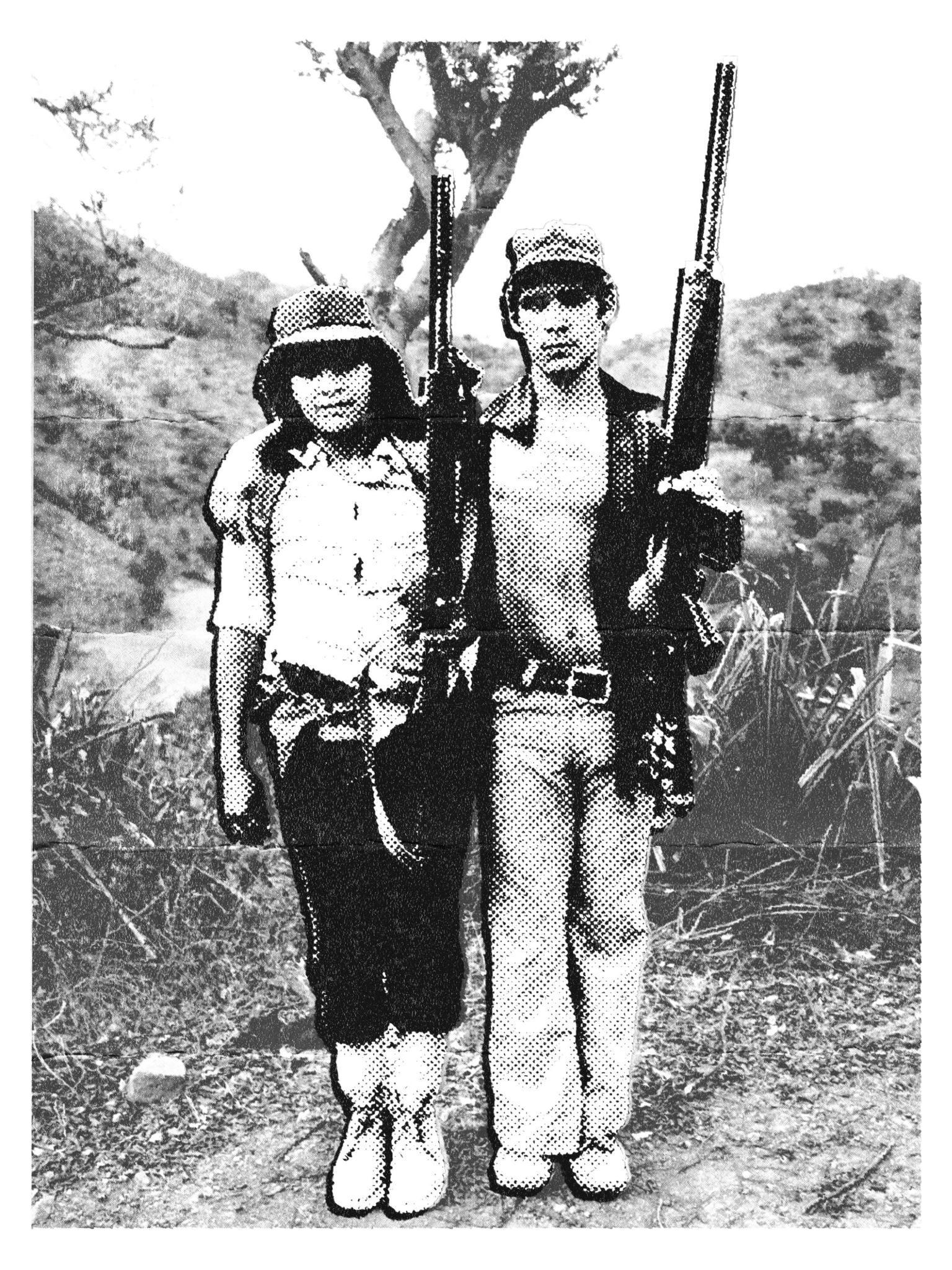
El Salvador. https://www.robertnickelsberg.com/elsalcolor
PART III: Bukele's Brigades
It’s a summer night, and the heat lightning is exploding over Apopa, painting the sky purple. We order three pupusas each and make small talk with the waiter. He glances over my shoulder. There are four soldiers patrolling the street. A small boy, no older than two, the son of one of the women who cooks here, points at them and cries out. The waiter swings the boy to his hip and rushes to the street. As the soldiers pass, he shouts, "Get out of here! Fuck off!" while bouncing the boy on his hip. As the waiter taunts the soldiers, the young boy shrieks with laughter.
The next day, we're lingering on the street corner near the pupuseria, waiting on a car, when another gang of soldiers approaches. The soldiers stare long enough at the woman flipping pupusas for her to know they will not be paying for their meal. She turns her head toward you, rolling her eyes: Do you see?You lift your sunglasses, return her knowing glance, and roll your eyes at the soldiers. The eyes know no language barriers.
El Salvador is overrun with brigades. The streets teem with gangs of soldiers walking about in groups of two, six, ten. They have their patrol routes, routines, and tasks. Some patrol with long guns. Groups of prisoners, on release to do public works, also line the streets and plazas of the country. Two arms of the regime, extended across the territory, molding and shaping public space, ordering it.
The soldiers are the more obvious and jarring presence. Young, soft-looking enlistees, children really. In combat uniforms, wielding hand-me-down M16A1s and A2s. The newly purchased Israeli Galils make up a decent chunk of Salvadoran arms imports, but they must be reserved for elite units and those guys wearing capes who stand at attention during Bukele’s speeches. They amble to-and-fro around town, popping into stores, squeezing a free meal out of some pupuserias; after years of constant presence, they don’t raise the temperature much.
In the early years of Bukelismo, they were certainly overzealous. They still confronted gangs in possession of actual territory. Moreover, the communities were as yet unaccustomed to the omnipresence of soldiers. The soldiers likewise did not yet understand the task assigned to them, and they exploited every opportunity they found to assert themselves. They encircled and occupied rough towns like Apopa with checkpoints in and out. They brought in police and soldiers from other towns. They transformed the municipal skate park into a barracks. In the middle of town, police officers stripped middle-class business owners down to their tattoos in plain view of their shop windows. The destitute and disposable were beaten in the street. This, however, was mostly a show of force.
The real regime was on the outskirts of town, in the colonias, previously under total gang control. The extraordinary claim that the State of Exception reestablished freedom of movement throughout the territory was not entirely true. Yes, gang boundaries that once cut neighborhoods in half were no more, and middle-class journalists could now go where they pleased. But come curfew hour in the peripheral areas, working-class residents faced ID checks and interrogations by soldiers. Mothers, who had to traverse town at odd hours for work, planned and requested their rides carefully. Their young sons' psyches wilted and broke under the daily gaze and questioning of the patrols.
Things have settled down a bit with the years; they’ve all gotten a bit more accustomed to each other, accustomed to this slow, quiet rout.
Maras & Policing
Mano Dura (2003) and Super Mano Dura (2004-2009) were the official ARENA (Nationalist Republican Alliance) responses to the gang problems created in the decade after the war. Ostensibly, these were tough-on-crime policies meant to weaken the gangs. In practice, the Mano Dura policies resulted in increases in short, arbitrary detentions of suspected gang members, who then gained further control of the prison system and developed more sophisticated organization. In 2012, under the first FMLN administration, the state arranged the first gang truce in El Salvador. In return for further benefits and autonomy behind bars, gangs reduced the homicide rate (by disguising their murders as disappearances).
Additionally, police were given orders not to patrol in neighborhoods under gang control. The truce showed that gangs were an independent political force in El Salvador, capable of manifesting their own interests and influence. The gang truce broke down in 2014 with the second FMLN administration, the first administration led by an ex-guerilla, Salvador Sánchez Cerén. The Sánchez administration further militarized the police by initiating joint police-military deployments and forming joint police-military anti-gang units. As a result, 2015 was the most violent year in El Salvador since the war.
Throughout these years, police death squads operated in collaboration with authorities. One such paramilitary group, Halcón 32, committed ninety-seven contract murders in and around the roughly twenty thousand person town of San Luis Talpa, some at the behest of a mayor, others for a local drug trafficker. The death squads helped local authorities eliminate competition in illicit business.
The Rise of Bukele
"GOOD DAY. PLEASE OPEN YOUR DOORS AND WINDOWS, COVER YOUR FOOD AND DRINKING WATER, AND VACATE YOUR HOME FOR THE NEXT THIRTY MINUTES. WE ARE FUMIGATING THE NEIGHBORHOOD."
We awoke to the crackling voice of a man speaking through hell's own megaphone. The fumigation brigade let themselves in through the iron gate separating the alley from the main street. They quickly get to work fogging the entire alley. We are able to get a glimpse of them through the window. They’re uniformed in the typical bright Dirección de Obras Municipales (DOM) T-shirts, with the same slick branding you always see: a clean modern logo, the updated "Gobierno de El Salvador" crest. They go up and down the alley with motorized foggers. The other brigades, while less immediately obvious, are not always so subtle either.
The regime has revamped and stood up new ministries in the last few years. Notably, DOM and MOPT (Ministry of Public Works and Transportation). Both participate in well-branded public works, clearly indicated with signage both during and after the work itself. The workers, deployed in brigades to job sites, are uniformed in new, brightly colored printed shirts. Projects include new highways to nowhere, tourist beach clean-ups, and anti-mosquito fumigation campaigns. The workforce for these ambitious and well-publicized works is, however, not military brigades. These are brigades of reos en fase de confianza—prisoners on work release.
The State of Exception and the skyrocketed prison population have secured the state a substantial labor pool in a country with low productivity that constantly bleeds its “skilled labor” to the North. Just this year, MOPT secured funding for another three thousand tracking bracelets for its work release program. Rumors abound. The national identification card (DUI) has a field for profession. Several people tell us that proletarian Salvadorans who are at the mercy of the regime are far more likely to be picked up if their DUI says they are a welder, carpenter, or other skilled laborer.
Dissidents in El Salvador have long learned to be wary of the state and even their own neighbors; first under the military dictatorship, then the many diffuse regimes of street gangs. Now, they also fear the intrusion of prisoner brigades into workplaces and residences. The regime gives a fumigator or municipal laborer on work release every incentive to snitch on politically sensitive matters, whether it’s to improve their own lot or avoid brutal consequences.
Nurturing Gangs
In 2012, shortly before Sánchez's anti-gang war, political marketer and advertiser, Nayib Bukele, joined his client party, the FMLN, and was elected mayor of Nuevo Cuscatlán. At the height of the Sánchez crackdown, in 2015, he was elected Mayor of San Salvador. While the highest levels of government were not actively negotiating with gangs under Sánchez, lesser and local actors did. Bukele used a network of handlers to negotiate control of the capital. He gave warnings before policing actions and offered preferential access and control of community assistance programs to gangs in return for cooperation with public order, gentrification, election campaigning and other such favors. During the 2014-2019 anti-gang war, San Salvador was a redoubt for the gangs, and Bukele independently cultivated their loyalty. When the FMLN expelled Bukele in 2017, he and the gangs had a shared interest in unseating the FMLN and installing Bukele as president. Bukele was a proven benefactor and partner of the infamous San Salvador gangs.
Street gangs went on to interfere in FMLN and ARENA attempts to campaign in working-class neighborhoods. In the lead-up to the 2019 election, they pressured family members and neighbors to vote for Bukele. They threatened and confiscated the DUIs of anyone who intended to vote otherwise.
Consolidation of State Power
On February 9, 2020—not one year into his presidency—Bukele sent forty soldiers, armed in plate carriers and helmets, to occupy the floor of the Legislative Assembly, pressuring the legislature to approve a $100 million loan from the US for security spending. Bukele's administration issued a state of emergency the following month. This enabled them to enact the strictest COVID-19 lockdown in the hemisphere. Police filled the prison-like quarantine centers with curfew-breakers. For months, authorities only allowed residents two weekly trips for food. In much of the country, restrictions on movement were enforced by military omnipresence. In San Salvador's poorest neighborhoods, which have the highest rates of informal employment, the government delegated lockdown enforcement and distribution of emergency aid to the gangs, long accustomed to monitoring and restricting the movements of their neighbors.
In anticipation of the February 2021 legislative elections, Bukele's arrangement of mutual support with the gangs continued. Nuevas Ideas—his political party—swept the legislature. In May 2021, the legislature voted to purge the Supreme Court. The Supreme Court was the last legal check on Bukele's power; the previous year, it struck down unconstitutional use of the military and arbitrary COVID detentions. Bukele had consolidated power across the entire government.
For Independence Day, September 15, 2021, many social movements convened the largest protest against Bukele to this day. They held a series of large marches over the next month. In October 2021, the Nuevas Ideas legislature passed a ban on public gatherings, citing increases in COVID cases.
One group that helped organize the Independence Day protest was the Alianza Nacional El Salvador en Paz (National Alliance for a Peaceful El Salvador), a coalition of former guerrillas and former military, continuing the long trend of ex-combatants finding themselves in struggles long after the war.
On September 3, 2025 the Supreme Court ruled that Bukele could run for an unconstitutional second term.
The State of Exception: Winnowing the Gangs and Total Sovereignty
In late March 2022, under the guise of routine negotiations, Bukele officials betrayed several of their long-standing gang allies, arresting key leaders. In retaliation, foot soldiers throughout the country unleashed a killing spree, murdering eighty-seven people over a single weekend. On March 27, 2022, the Legislative Assembly granted President Bukele a state of exception, which has been renewed continually ever since.
Within ten months of mass arrests and the military occupation of poor neighborhoods, the government broke the territorial control of the street gangs. Decades of rent extraction, extortion and limited mobility ended almost overnight. However, freedom of movement remains highly constrained by state security forces. In the first years of the State of Exception, poor urban neighborhoods and municipalities were regularly subject to outright cordoning.
In May and June 2024, three years after mass protests against the regime, police announced the arrests of eleven senior citizens. The government claimed they planned to bomb Bukele’s illegal second inauguration. The story unraveled fast. In May, officials announced arrests that had not yet taken place. One of the supposed suspects had been dead for months.
One fact stood firm: all the men eventually arrested were veterans of the armed conflict. They belonged to Alianza Nacional El Salvador en Paz.
In 2023, authorities arrested five former combatants—community leaders and environmental activists in the anti-mining movement that won the 2017 ban on metallic mining. Prosecutors charged them with dubious “war crimes.”
Many saw the arrests as a warning. Bukele planned to repeal the mining ban. He did so just before Christmas 2024. It marked his first widely unpopular move since he imposed the State of Exception.
Plan Cero Ocio & CECOT
Between March 2022 and March 2025, after three years of the State of Exception, Salvadoran security forces report detaining 85,000 people (1.4% of the population). Some estimate the total prison population to be 105,000 to 107,000 (up to 1.8% of the population) with three out of every one hundred men currently incarcerated.
The exploitation of prison labor and its spectacular representation is a cornerstone of the State of Exception with the Plan Cero Ocio (Plan Zero Leisure). As of March 2025, it claims to “employ” 37,000 incarcerated workers. The government aspires to enslave 48,000 people (0.8% of the population) this way.
Reports show prison laborers working on the private property of the prison minister’s wealthy friends. But the model project under Plan Cero Ocio is school construction and renovation. The work folds into Bukele’s Plan Dos Escuelas Por Día, which promises two new schools each day. Officials assign prisoners to projects the public can see and applaud. They build schools, sew uniforms, scrub graffiti, collect trash, and hand out aid. Each job signals order restored.
In the first months of the State of Exception, when Bukele first announced his intentions to construct the CECOT megaprision, his plans went unremarked in the American press. By the time the Centro de Confinamento de Terrorismo, or Terrorism Confinement Center, was inaugurated in 2023, information was scarce, even for intrepid local and international Spanish-language press.
The government claimed the facility held forty thousand prisoners. This would make CECOT the largest prison in Latin America, and among the largest prisons globally. The facility doubled El Salvador's prison capacity. Under the State of Exception, the country’s incarceration rate rose to the highest on earth.
With independent and corporate media shut out, the regime controls the story and the image of CECOT. In February 2023, officials announced the first transfer of two thousand prisoners. They released slick, tightly edited footage. Guards drove thousands of men with shaved heads, stripped to basketball shorts, into the prison at a run. The men hunched forward as cameras followed.
Guards packed them into rows. Each man pressed his forehead to the shoulder blades of the man in front of him and wedged himself against the legs of the man behind him. Drones filmed from above. The rows blurred into a single mass of flesh. Later, some observers noted similarities between the conditions and exposure imposed on detainees in CECOT and those used by the IDF on Palestinians in Gaza.
The regime would later bring in select personalities to film CECOT, with a preference for sycophantic YouTubers and, later, MAGA politicians. In all cases, these portrayals would highlight the facility's exceptional scale; however, the prison is not an exception from the norm of torture, abuse, and neglect in El Salvador's less modern prisons.
Prison of the Americas?
In March 2025, the US Immigration and Customs Enforcement (ICE) chartered three flights carrying over two hundred Venezuelan migrants—alleged gang members—from the US to El Salvador. Also on those flights were a handful of high-ranking Salvadoran gang members who were previously set to testify in US Federal Court. These leaders’ testimony could possibly reveal details of illegal gang negotiations with Bukele. In the previous month, Trump’s State Department struck a deal with the Bukele regime; in exchange for $6 million, and possibly other favors, El Salvador would hold Venezuelan deportees in CECOT. Neither regime has explained why the gang leaders were deported prior to testifying.
One Salvadoran man deported to CECOT on a March 2025 flight became a household name in both the United States and El Salvador. Kilmar Abrego Garcia was deported due to an “administrative error.” A judge permitted Kilmar's presence in the US in 2019. The "error," as admitted by the government in court, inflamed the outrage of Americans and Salvadorans alike.
The use of CECOT to confine American migrants under the label of “terrorist” fuses two tracks: safe third country agreements and extraordinary rendition. Safe third country agreements allow the United States to send asylum seekers to other nations while their claims stall or die. These countries rarely offer real safety or a future migrants would choose. “Extraordinary rendition”—state-organized kidnapping—came into popular parlance during the US-led Global War on Terror. The United States sent terrorism suspects to third countries known for harsh interrogation, often with CIA support. The US used allies such as Egypt, Syria, and Jordan to torture and kill detainees. Many of these prisons, widely known as “black sites,” operated in secret.
CECOT is not a black site. The governments of El Salvador and the United States flaunt it. Its power comes from its spectacle, not from secrecy. Yet the migrants held there exist in the same extrajudicial limbo born of the War on Terror. They face confinement without clear legal recourse, and reports point to torture all the same.
The United States and its lesser partner regimes, like El Salvador, continue to contort and stretch the ever-plastic category of "terrorist.” Recently, the word has been expanded to include members of street gangs, then migrants, and now, US citizens who defend their neighbors from federal occupation. The category of the “terrorist" will continue to morph so long as it lends governments limitless power to pursue financial, industrial, and geopolitical aims. Domestic law enforcement will further resemble Special Operators from the US Army. The scope and breadth of detention and disappearance by the state will expand. It is not difficult to imagine a future where American citizens are detained in CECOT, a notion Trump himself has publicly suggested. If this is to be the case, the movement against the State of Exception in El Salvador may find new allies in the US.
Visit the regime's preeminent tourist beach, El Zonte, on a sleepy Tuesday afternoon. You may be surprised; you may find something of a ghost town, haunted by some of the few white European and North American tourists in the country. The streets have been penned in, perhaps to corral these poltergeists, to prevent them from wandering off into the rest of the country. The playpen is tidy, the walls are white, the streets are clear, and the beach is clean—thanks, in no small part, to the brigades of enslaved prisoners. One wonders if the Northern tourists can even see what's before them. Do they ask themselves why these men are lined up on the beach under watch of an officer, rifle in hand?
Do they see the loop close on this figure 8? At one end—back home—the immigrant and the settler meet; the one cleaning the dishes, making the food, tending to the lawn of the other. Then through the crux of CECOT, we arrive at the other side: tourists removed from the stress back home, basking on the beaches of a penal colony.
Nearly three million years ago, the long revolution of subduction and fire lifted the Central American isthmus from the ocean floor. It split one vast sea into the Atlantic and the Pacific and stitched the Americas together. Stand anywhere along the Pacific coast, from Chile to Alaska, and look out at the horizon. Beneath that wide calm, the old force keeps moving. The earth turns in on itself. It slips into subduction zones below our feet, then rises again, molten and bright. This motion came long before us. It will remain after we are gone.
Those of us who dream of the world erupting into revolution know our fates are bound with those on continents far away, in times long past. We have brothers working shipping drayage to the port of Long Beach. Sisters in the cane fields between San Salvador and the coast. For Earth to erupt in one great sequence of revolutions, overturning capitalism's scars on the geologic record, we must shake the earth together where we stand and raise a new horizon for humanity from its depths. Only then, the ground will tremble and empires will crumble. Somewhere over a cresting wave, beyond the black volcanic sand, we've seen a glimmer of this. We hope you will, too.
APPENDIX: Amor al Mundo—Principles for Political Travel
1) Speak the language. Listen to podcasts. Watch movies and TV. Don’t worry about sounding awkward—you’re learning. Memorize the fifty most common verbs and a few adjectives; then you can describe any noun you don’t know. Methods that use positive language transfer, active recall, and immediate speaking practice work better than apps or textbooks. Look for a weekly conversation table in your city, or ask a friend to host one with you.
2) Study the history and political terrain. Use documentaries, books, social media, and podcasts to learn your destination’s history and current events. Focus on revolutionary struggles, social movements, political repression, and political prisoners. Independent news sources offer critical insight.
Study the city on a map beforehand to plan and adjust on the fly. You don’t need a PhD—knowing the people’s history and geography is enough to spark conversation and show respect.
3) Cultivate interest about your trip among friends and comrades. Our travels are never just ours. Share your plans with trusted friends. A Signal thread can keep them updated. Take note of what you’ll report back. You’ll be surprised how many will support your trip and your work on the ground when you have a clear plan for study, documentation, and follow-up.
4) Listen and observe with calibrated discernment. We move through our own political worlds using familiar heuristics to judge strategies, events, and tactics. Those shortcuts often fail in new contexts. A prison riot led by right-wing forces and gangs in Guatemala is not the same as a self-organized rebellion in a US prison. Broad similarities matter less than the differences. As you travel, listen to people and events on their own terms. Your task is to understand those terms.
5) Lead with warmth, humility, and curiosity. In many places, you may find yourself, often unknowingly, sitting with a participant of a revolutionary civil war. They defy assumptions about age, race, gender, or education. The most compelling stories come from unexpected people. Here, warmth, humility, and curiosity matter more than your own political experience—they invite stories and analysis. This is the core principle of political travel.
6) Document your observations and interactions. Keep a travel journal. Write every day, even if just a bullet list of places, observations, and quotes. Add longer reflections when you can. Make a list of questions for people you meet and gather questions from comrades. Use a voice recorder for interviews. Store all documentation on an encrypted flash drive or cloud. Relationships are your most valuable asset—never carry unsecured records on devices or across borders.
7) Plan for reciprocity. Plan a short presentation on your own political context and share it with friends and comrades you meet. Remember many countries are small—your audience may need context on US geography, racism, policing, and militant struggles.
As you build relationships, think about the skills and resources you can offer in the medium and long term. If you stay in someone’s home, consider what you bring to it. When you return, give a report-back: the recent history of the place, who you met, their lives, and the outcomes of recent struggles. Connect their strategies and objectives to your own context.
8) Stay in touch.